How Football’s Captain’s Armband Became a Matchday Signal
Learn how the football captain’s armband identifies a matchday role, why its design varies, and how to tell who is currently wearing the captain’s designation.
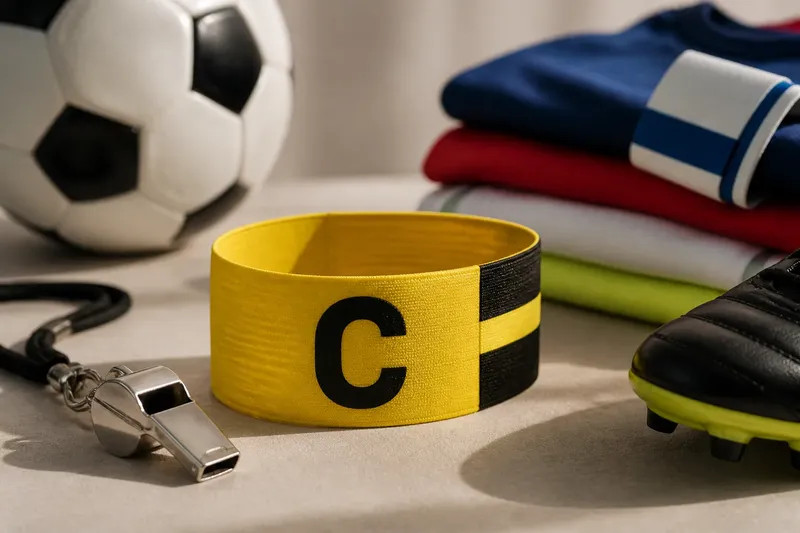
At kickoff, a player in a bright band steps toward the referee while teammates take their places. The football captain’s armband makes one matchday role easy to spot, but its changing designs can leave viewers unsure what the band tells them.
The clearest account is a modest one: the armband is a visual signal for a captain already designated by a team. It did not create the captaincy, and there is no single documented path by which every club or competition adopted it. Match rules and team customs determine how the role is identified today.
The captaincy predates the armband as a visual signal
A team can appoint a captain without relying on any particular garment. The role is part of a team’s organization; the band is one way to make the appointment visible to players, officials, and spectators.
That distinction matters when describing the armband’s history. Without a documented date, competition, or example, it would be misleading to claim that one event or universal rule introduced it. A safer explanation is that teams and competitions have used the band as a practical marker, while the exact custom and requirements vary.
The band works like a name tag at a busy meeting: it helps identify one person quickly, but it does not explain every responsibility attached to that person.
The band makes an existing appointment easier to see
During play, players move across the field and broadcasts follow the ball. A distinct band gives viewers and match officials a quick visual clue about who is serving as captain, even when the player is away from the action.
The band may also be visible before play, such as during team introductions or the exchange with officials. Those moments help connect the captain’s identity with a face, but they do not establish a universal history or fixed design.
Color, lettering, and other details can differ by team, competition, or occasion. A changed design alone does not show that the captaincy has changed; it may reflect the kit instructions for that match.
Why does the captain’s armband vary between matches?
Why is the band a different color from the shirt?
A contrasting color can make the marker easier to distinguish from the shirt and nearby players. A competition’s kit requirements or a special match design may also affect its appearance.
Does every captain have to wear an armband?
Requirements depend on the competition and its rules. Check the relevant competition guidance or match information rather than assuming that every team must use the same visible marker.
Can the captain change during a match?
A captain may be substituted or leave the field, and another player may take over the designation. The team’s procedure and competition rules determine how the change is handled and whether the band is passed on.
Does the armband show who directs the team’s tactics?
No. It identifies the appointed captain, not necessarily the player calling every tactical adjustment. Coaches and players may share those responsibilities.
Competition instructions can shape the band’s appearance
Some competitions specify how a captain should be identified or provide a required design. Others leave more of the choice to teams. The applicable competition rules and kit instructions are more reliable than assumptions based on a band seen in another fixture.
A vice-captain and a matchday captain are not always the same person. A squad list may identify the player appointed captain in advance, while a substitution or other change can affect who is serving in the role during the match. Use the team information and what happens on the field together.
What should you check when the captain is hard to identify?
Where can you confirm the captain’s name?
Check the official team sheet or match lineup if it names the captain. If it does not, treat the name as unconfirmed and look for a visible band or an announcement rather than guessing from a player’s reputation.
What if the band blends into the shirt?
Look again during a stoppage or in a wider camera view, when the player’s arm may be easier to see. If the marking remains unclear, keep the identification tentative instead of inferring it from who speaks most.
How can you tell if the captain changes?
Watch for a substitution or a clear handover of the band, then check whether match information confirms the new designation. If the evidence is incomplete, distinguish what you saw from what is officially confirmed.
Use visible evidence to follow a captaincy change
Say the official team sheet names Maya as captain, but the broadcast shows a band that looks much like her sleeve. During a stoppage, a wider view reveals the marking on Maya’s arm. Later, Maya is substituted and a teammate takes the band; the handover supports the observation that the teammate is taking over the matchday role, though the team sheet may still reflect the original appointment.
- Check the team sheet. If it names a captain, use that as the listed appointment; if it does not, treat the captain’s identity as unconfirmed and look for another official match source.
- Inspect the band during a stoppage. If its color or marking is visible, use it as a field clue; if it blends into the shirt, wait for a clearer angle rather than guessing.
- Compare the band with the player’s sleeve. If the marking is distinct, note who wears it; if the view is obscured, keep the identification tentative and seek a wider shot.
- Watch the pre-match exchange with officials. If a player’s identity is clear and the match context supports the identification, treat it as a clue; if not, confirm through the team sheet or another official source.
- Notice substitutions and handovers. If the band visibly passes to a teammate, note a likely change in matchday designation; if no handover is visible, avoid assuming who took over.
- Separate leadership from the official role. If a player gives instructions, regard that as evidence of on-field communication; if you need to identify the captain, rely on the band or match information instead.
The armband identifies a role without explaining its limits
The football captain’s armband is useful because it makes an appointment visible, not because it reveals how the team selected its captain or how much authority that player has. Read the band as a matchday identification cue, then use the team sheet and any visible handover to understand changes.
That approach also keeps the history in proportion: the captaincy and the symbol are related, but they are not the same thing. When a band is hard to see, the most accurate answer may be that the captain’s identity is not yet clear.